
The new normal for conversion attribution: data-driven models reveal hidden value
Google’s default attribution model has led most advertisers to give all the credit to the last click. But this model often ignores the traffic and contribution that other media bring along the way. To allocate media budgets more effectively, marketers need a fuller view of the value of every touchpoint. So which attribution model meets that need?
From Q2 2022 (date not yet confirmed), the default attribution model in Google Ads will change from last interaction to data-driven attribution (DDA), and new conversion actions will use DDA by default. For existing conversion actions, Google will also remove the previous data thresholds: ad accounts will no longer need 300 conversions and 3,000 ad interactions within 30 days to use DDA.
What is data-driven attribution (DDA)?
Data-driven attribution (DDA) uses machine-learning algorithms to compare and calculate the performance of each touchpoint on converting and non-converting paths. It takes into account factors such as time to conversion, device type, number of ad interactions, the order of ad exposures and the type of creative assets, to determine which touchpoints are most likely to lead to a conversion, and then assigns conversion credit to each marketing touchpoint.
Why use DDA?
Previously, Google Ads attribution tools only applied to the Search Network and Shopping ads, and other ad formats were credited on a last-click basis. With recent Google Ads upgrades, YouTube and the Google Display Network (GDN) are now included in the calculation. This lets marketers using DDA see each channel’s contribution to conversions more fully and have more data to support their communication planning. It helps clarify the role of each medium and how to allocate budget, and lets them assess ad performance across the full funnel and capture more potential opportunities.
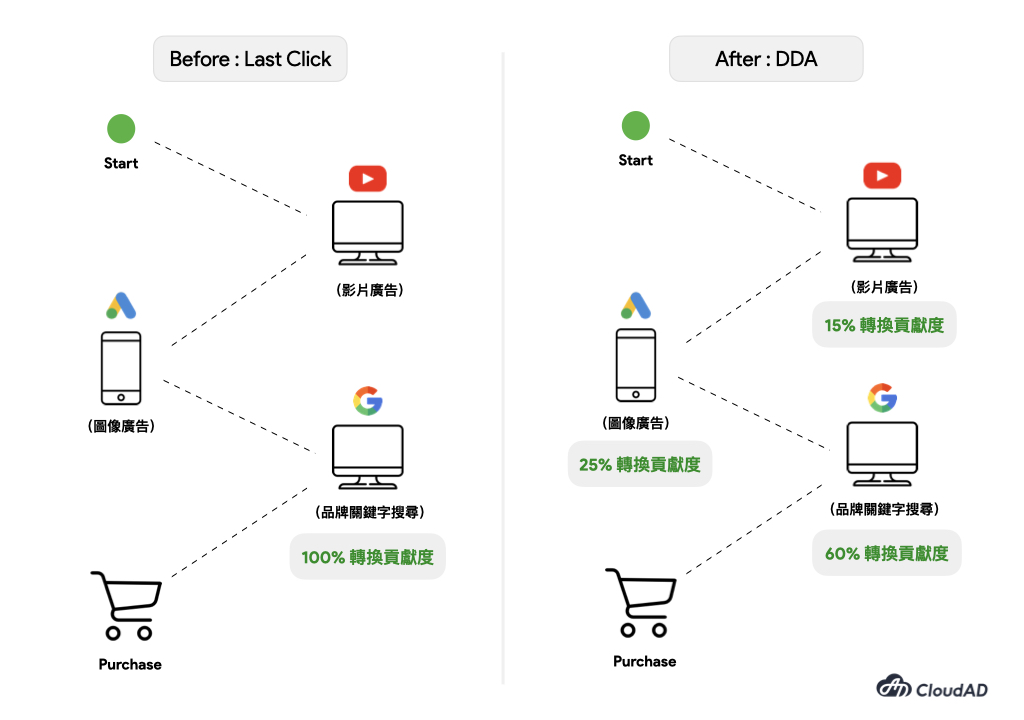
For example, when marketers use last interaction as the attribution model, 100% of the conversion value is credited to the last interaction channel, however many ads the customer saw before converting. With DDA as the attribution model, the system automatically calculates the actual credit for each click interaction based on the data for each conversion event, restoring the value of each touchpoint in the customer journey.
Two tips to speed up results
Using DDA on its own only changes the conversion data in your reports; it does nothing for ad performance. To get real value from DDA, you need to combine it with Smart Bidding and adjust media budget allocation based on performance.
1. Use Smart Bidding and adjust values
Use the performance value restored by the DDA model as the basis for Smart Bidding. This helps the machine learn effectively, giving you tighter control over ad costs and higher revenue value.
When reviewing performance, we also recommend excluding data from the last few weeks (or a period set according to how long your customer journey takes), so that the time lag between click and conversion does not make bidding less accurate and affect ad performance.
2. Adjust budgets across all channels
By restoring conversion contributions, DDA helps advertisers understand how much each media channel contributes to actual results. Comparing the performance of each channel lays the groundwork for budget allocation and gives advertisers a more complete full-funnel plan.
Data-driven attribution relies heavily on data and is where the industry is heading. Make good use of DDA to understand which ads deserve more credit for driving conversions. Combined with Smart Bidding and a cross-channel budget allocation strategy, it helps you run campaigns more efficiently and improve overall conversion performance. To find out more about our marketing strategy and ad optimisation services, get in touch.