Q4 2023 will soon be here. Consumers are starting to plan their shopping earlier every year, but what else can you do to get ready ahead of time?
This year could almost be called the first year of AI, and marketers are no doubt keen to try the AI advertising tools now available to them. But what groundwork do you need to do before running AI-powered ads? CloudAD has put together the trends you need to know and a preparation checklist for the coming shopping season.
1. Trends
The shopping season always starts in June each year. What should you pay particular attention to? Google research found the following trends:
- The run of shopping festivals across Asia Pacific has become a non-stop marathon.
From the 618 shopping festival and the Ghost Festival to monthly sales, these events now run into each other to form one long shopping season.
- Sales events are very popular in a time of inflation.
In fact, newer double-digit shopping festivals such as 7.7 and 8.8 are gradually becoming as popular as well-known festivals such as Double 11 (11 November).
- The “confidence gap” during peak shopping periods is growing.
More than a third of shoppers in Asia Pacific worry that a product they buy during a sale may be cheaper in another promotion in the same season. This has led many people to abandon their baskets, and after the 2022 holiday shopping season, returned orders rose 63% year on year.
2. Three stages of preparation: a quick health check
Given this year’s trends, building consumer trust is increasingly important. One misstep, and consumers may stay stuck in the hesitation phase of their shopping journey. As an advertiser, you need solid marketing fundamentals so you can respond to whatever changes come. CloudAD has put together three stages of preparation so you can run a quick health check and have a strong season.
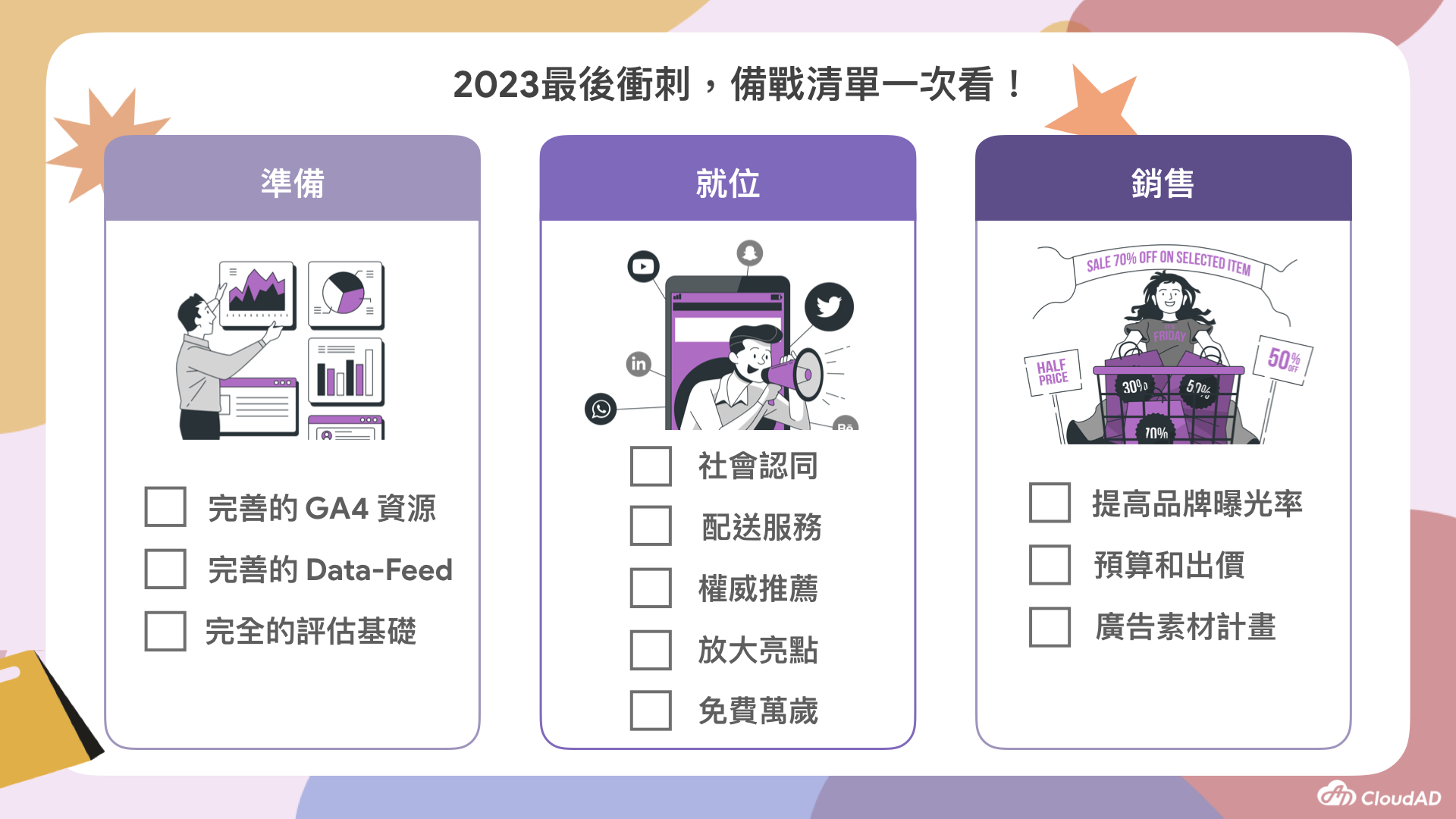
Stage 1: Get ready
To get the best results from the shopping season, CloudAD recommends the following foundations. All of them are essential, and there is still time to put them in place now.
- A well-configured GA4 property: a successful digital advertising strategy needs a healthy data environment, so you can build up and understand where your website users come from and how they behave. Wherever you plan to invest your marketing resources, we recommend using GA4 to align data from every channel, so you can review performance fairly and objectively.
- A complete data feed: reducing the friction between customers and products is a challenge for many marketers. If it is for you too, let data tools solve it. Whether you use Google Merchant Center (GMC) or a Meta catalogue, API technology can connect your ads to live product information, so customers can see a product’s key selling points without having to visit your website, which increases the chance of conversion.
- Complete measurement foundations: set up Google Ads enhanced conversions and the Meta Conversions API, so ad conversions can still be measured correctly under privacy policies and your marketing strategy can be adjusted on an ongoing basis in the right direction.
Stage 2: Get set
Send shoppers the right messages to help them make purchase decisions with more confidence. Beyond offering promotional prices, you can plan your marketing tools and product content around the following angles to stand out in a competitive market. According to research, if you can deliver on all five points, the boost to sales is equivalent to offering a 15% discount.
- Social proof: it’s not only people who need to build recognition. Your product needs it even more. Most consumers search online before they buy. Plenty of good reviews and strong sales figures help a product make a good impression in this competition.
️ CloudAD tip: you can improve credible reviews of your brand or product through word-of-mouth marketing. The word-of-mouth you build up may also appear in Google search results, giving you an SEO benefit.
- Delivery: free shipping, same-day delivery, in-store pickup and fast delivery are all key factors for consumers. If these are strengths of your product, make sure consumers can see them.
️ CloudAD tip: in Google Merchant Center, mark products with free shipping and fast dispatch, and set up your returns policy, to give consumers more confidence to buy.
- Expert recommendations: experts in a field know better than ordinary people whether a product is effective and safe. If your product is recommended by people in the relevant industry, it can quickly persuade consumers.
️ CloudAD tip: once you have an expert’s recommendation, we suggest using Meta’s “partnership ad” permissions and “branded content” posts, so your digital ads amplify the link between your product and the expert and strengthen consumers’ recall and trust.
- Highlight key selling points: consumers rely on mental shortcuts and rules of thumb. If you can amplify your product’s strengths, such as a laptop with more than 12 hours of battery life or pet food with 100% natural ingredients, your product can become the brightest star in the market.
️ CloudAD tip: many brands put the product’s appearance at the centre of their ad creative. If appearance isn’t what wins in your market, we recommend giving the space to “key selling points” like those above.
- Everyone loves free: everyone loves a free gift. If the item has a high market value, it feels to consumers more like winning the jackpot, and it’s a powerful way to prompt them to buy.
️ CloudAD tip: free services and free gifts are both strong incentives. As well as using them in ad images, we recommend adding them to text ads such as Google search ads, so consumers can see the key points at a glance.
Stage 3: Sell
Build a range of communication channels and ad tools, each with its own role, to create a healthy, complete marketing funnel and improve the return on your marketing budget.
- Increase brand reach: as well as investing in Google and Meta conversion ads to drive sales, we recommend using awareness and traffic ads to extend your brand’s reach and support the top of the funnel.
- Budget and bidding: plan your budget before the peak season arrives. Today’s AI ad tools all need a long period of machine learning. Use a bid strategy that matches each campaign’s objective, so the AI learns in the right direction, adapts to seasonal changes in consumer trends, and wins you the highest possible sales.
- Ad creative plan: assess how well your creative suits consumers. For Google Ads, we recommend aiming for an Ad Strength rating of “Excellent”. For Meta, check whether the quality, engagement rate and conversion rate rankings in the system reach “Above average”, so the ad algorithm favours your ads and you get better results in the auction.
- Measuring performance: use each metric in the ad platform to evaluate performance and start improving your campaigns. During the highly competitive shopping season, use auction insights to track how competitive the auction is. If you are a retailer with physical stores, evaluate how online ads affect your stores, including store visits and store sales metrics. Giving this data to Smart Bidding helps increase total sales across online and physical stores.
You don’t have to prepare for the shopping season alone. CloudAD can work with you to get great results. Whether you need help with data integration or ad strategy, get in touch.