About the client
MR. LIVING (居家先生) aims to offer Nordic design furniture that everyone can afford, for a better life. Working with established and emerging designers from the Nordics and the UK and with international manufacturers, it sells direct to consumers (D2C) at around 40 to 60 percent of typical retail prices.
Unlike the offline sales mindset common in the industry, MR. LIVING also values online-merge-offline (OMO) as a source of sustained growth.
The challenge
Looking at Taiwan’s consumer market, CloudAD saw rising housing and living costs limiting spending power. Alongside the growth of online shopping and a post-pandemic surge in offline spending, Google research found that:
- About a third of consumers consider more brands before deciding.
- Nearly half change the brand they finally buy while researching.
Businesses have had to work harder, relying on cookie tracking and digital ads to keep hold of customers. But privacy policies now leave part of consumers’ online activity unidentifiable, and switching devices, logging in with different accounts or browsing privately all make identification harder. Finding a marketing path that respects privacy and opens new ground has become a top challenge for many businesses.
Strategy: four steps to reconnect customer acquisition
To offer the market the best solution, CloudAD, as a specialist in data technology and marketing strategy with the business goal of data-driven brand growth, started from first-party consumer behaviour data. Partnering with iPASS (一卡通), which runs a wide range of everyday services, we brought first-party behaviour data from different settings to the brand, reached people seamlessly through SMS, a stable channel, and fed high-potential audiences into Meta ads for segmented communication, getting the full value from the data.
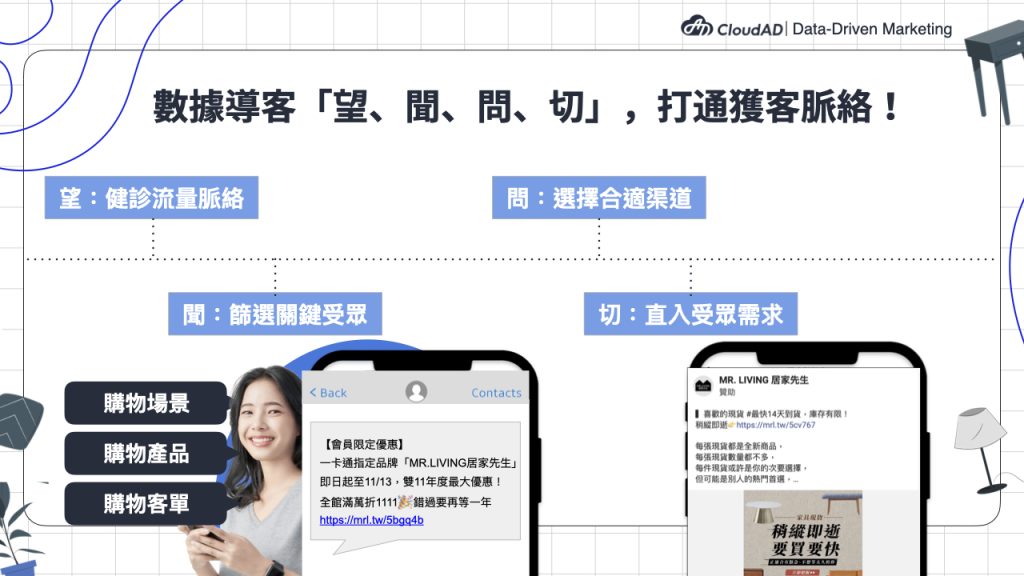
CloudAD framed the strategy as the four steps of traditional Chinese medical diagnosis: look, listen, ask and feel, to nurture the brand’s traffic pool and maximise the return on ad investment.
- Look: check the flow of traffic. Traffic is where a brand’s customer flow begins. Before the Double 11 shopping festival, the brand needed more new customers so that conversion-focused ads had enough signals for machine learning. Because privacy policies make it harder to find new customers on current ad platforms, CloudAD recommended iPASS’s precision audience solution as the starting point.
- Listen: select the key audience. iPASS has a rich behaviour database, but design furniture has a higher price and depends on taste, so buyers consider for longer. CloudAD selected people who had shopped at department stores above a certain spend and had bought lifestyle or furniture products, and excluded those who had bought furniture in the past six months, given how rarely furniture is repurchased. SMS reached this audience with little friction, and link clicks showed who was truly interested.
- Ask: choose the right channel. Nordic design furniture wins customers through design and looks, so the channel matters. Meta, a large and highly visual social platform, is ideal for showcasing design furniture. Its lookalike audiences found users similar to those who clicked the SMS link, and ads ran across Facebook, Instagram and the Audience Network, bringing fresh traffic to the brand.
- Feel: go straight to what the audience needs. Reaching the right people matters, but so does reducing their effort to decide. Creative ran on several angles at once, from best-seller recommendations to Double 11 buying guides, to meet audiences at different stages of the journey.
Results
- Cost per click down 25.16%
- Average engagement time per session up 12.04%