Google’s Taiwan market insights, published in August this year, note that 2.5 billion users worldwide now get information through AI Overviews every month, and AI Mode has passed 1 billion users. The same data includes a figure that is even closer to business itself: as many as two-thirds of Taiwanese consumers say AI search has helped them discover brands they were previously unfamiliar with, or had never heard of.
This means the way consumers look for information, compare options and make decisions is already changing. In the past, whether a brand could be found depended on keyword rankings. Now there is an extra hurdle: whether the brand makes it into the answer the AI gives. We have looked at this shift in the entry point before. The core issue is not that the entry point has changed, but whether your content is ready.
1. What AI is changing is the act of “being discovered” itself
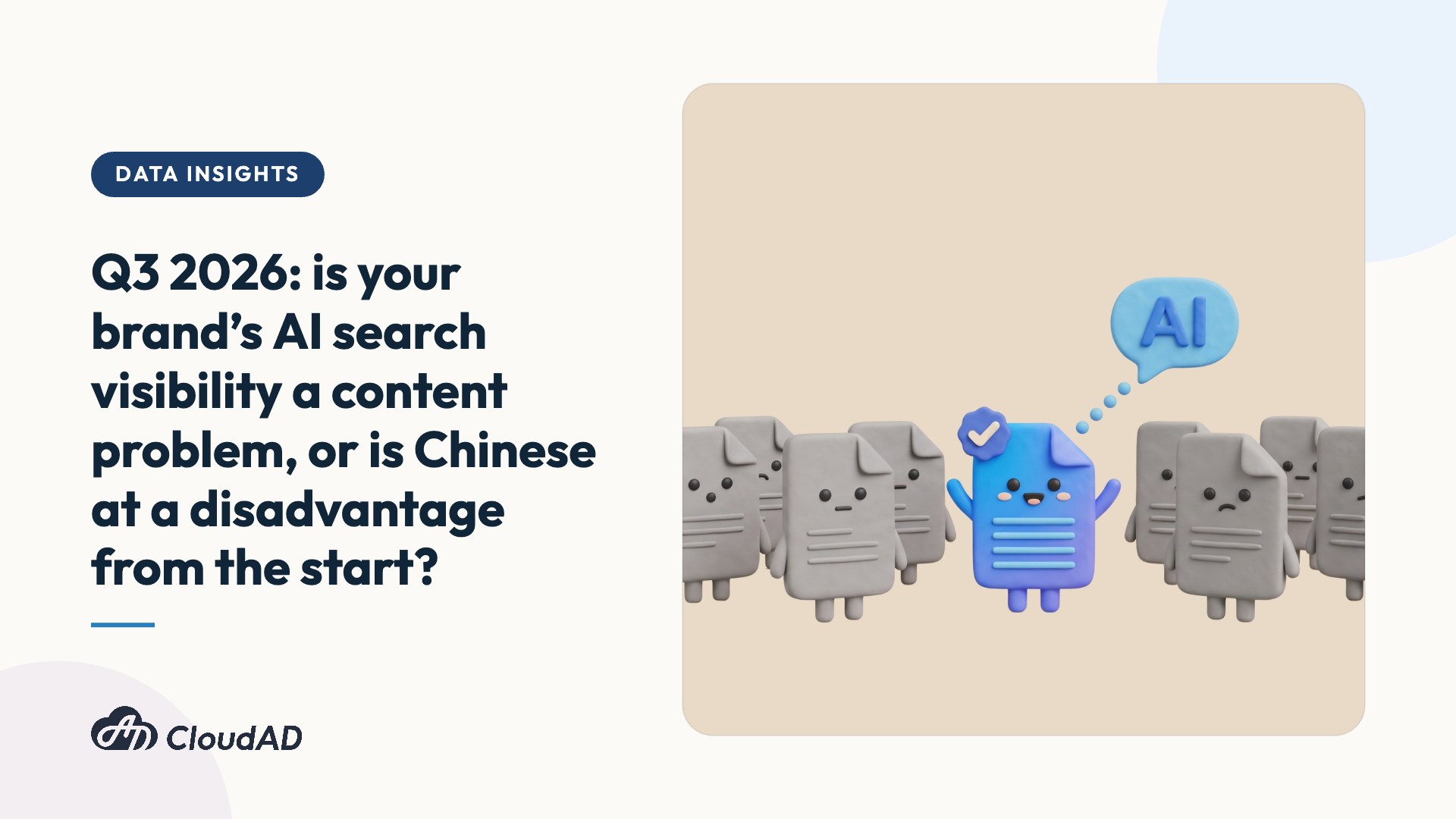
Beyond rankings, there is now another question: when a consumer asks AI “which one should I choose?”, does your brand appear in the answer? This is not an extension of ranking logic but a new battleground for visibility. How AI understands your brand, and how it decides whether to cite you, follows a different set of rules from traditional SEO. We once ran an experiment on CloudAD itself without knowing the outcome, testing whether the brand was counted in the answer when customers asked AI “who should I go to in this field?”.
2. In this race, Chinese does not start from the same line
There is another layer of background that Taiwanese brands can easily overlook. In its analysis of language gaps in generative AI, the US think tank the Brookings Institution points out that only around 20 languages worldwide are classed as “high-resource languages”, meaning languages with enough training data to support effective learning by AI systems. How rich the data is for a language directly affects how well AI systems understand it and perform in it.
In other words, Chinese content does not start from the same line as English content in the AI citation ecosystem. This is not because any particular brand’s content is not good enough. It is a structural gap that exists at the level of language and market, and it needs to be acknowledged before the next step can be discussed.
3. Being cited does not mean you will stay visible
Another easily overlooked point is that an AI citation is not something that stays effective forever once you get it right. A large empirical study of Chinese-language AI search engines published in July this year (covering 4 mainstream platforms, 614 queries and about 161,000 citation records; the platforms studied were mainly mainland Chinese ones, not the same set used in the Taiwan market, but the structural patterns in citation behaviour are still worth considering) found that the probability of a brand being cited in an answer was only 8.3%. And cited content had a half-life of only 39 to 68 days. After that, the likelihood of the same content continuing to be cited starts to fall. Even the app and web versions of the same platform did not cite exactly the same sources.
This shows that AI citation is dynamic. It changes with time, platform and model version, and it is not something you set up once and then close.
4. What this means for Taiwanese brands
Taken together, the three points above say this: the share of consumers discovering brands through AI is already high (1), Chinese-language content starts further back in this ecosystem (2), and even if you get it right, your visibility fades over time (3). Combined, this means AI visibility is not a one-off project but a state that needs ongoing tracking. That is a different kind of work from a one-time website health check that ends once it goes live.
5. You can see the score, but you can’t measure the business
Various “AI visibility score” tools are starting to appear on the market. These scores do have reference value, showing how strongly a brand is present across different AI platforms. But the score alone cannot answer the next question: whether changes in traffic from AI search are actually reflected in the business.
Behind this question is a more basic premise: can your current measurement foundation show you “what happened”? Whether you use the free version of GA4 or the enterprise version, GA360, if traffic sources are not tagged correctly, if the conversion path itself has gaps, or if your reports only show totals rather than the structure of sources, then even if AI search really is bringing you new traffic or taking existing traffic away, you may not be able to see that it is happening at all, let alone judge whether and how to deal with it.
This is why, rather than chasing an AI visibility score, reviewing your measurement foundation is usually the step to take first. It is the same direction as the self-check to run when traffic comes in but does not convert: first make sure you can understand your data, then decide whether to chase a new score.
Frequently asked questions
How high does an AI visibility score need to be to be safe?
There is currently no agreed safe threshold in the industry, because the score itself fluctuates with model version and how queries are made. Rather than aiming for a single number, what matters more is whether you can consistently track how that number trends, and whether those changes correspond to real changes in traffic or conversions.
Are Chinese-language brands destined to be at a disadvantage in AI search?
There is a structural gap at the starting line, but it is a market-level phenomenon, not a problem any single brand can solve alone, and it does not mean there is nothing you can do. What you can do is first make sure your measurement foundation keeps up, so you can tell which efforts are actually working.
Which can show the impact of AI search, GA4 or GA360?
Both can. The difference is in feature scale and data retention, not in whether they are capable of it. In most cases the problem is not the tool version but whether traffic source tagging and conversion settings are correct, and that can be handled in GA4.
Should traffic from AI search be looked at separately from ordinary organic search traffic?
We recommend tracking them separately. Consumers in the two types of traffic may have different intent and be at different decision stages. Looking at them together can hide the changes you really need to pay attention to.
How often should you recheck AI visibility?
There is no fixed cycle. But since the effectiveness of cited content declines over time, it is better treated as a tracking item that is reviewed regularly rather than a one-off check. The frequency can depend on how competition is changing in the brand’s industry.
AI search is changing how brands are discovered. This is already happening, and there is data to back it up. But for most Taiwanese brands, rather than rushing to chase an AI visibility score, the thing worth checking first is whether your own measurement foundation is in place. If you cannot clearly see where traffic comes from or whether it converts, any new change in visibility will just be a number you cannot interpret. This is usually the first thing we help clarify when we run a data health check.
Sources: Think with Google Taiwan (August 2026); Brookings Institution, “How language gaps constrain generative AI development”; arXiv 2607.15771, “What Do Chinese-Language Generative Search Engines Cite and Surface?” (July 2026).