Three common scenarios. A social media editor uses AI to write posts and publishes them, but nobody knows whether performance improved. Sales staff each use AI to write outreach emails, and the best version stays in one person’s chat window. The boss asks ChatGPT late at night “how should the company use AI?” and gets an answer that sounds very sensible but leads to nothing that can be done the next day.
If these scenarios sound familiar, there is a more direct question worth asking first: can the AI subscriptions being charged every month point to any number in the company that they’ve changed?
This isn’t one company’s story. According to the “2026 Taiwan Industry AI Adoption Survey” published in May this year by the Taiwan AI Academy Foundation (AIF), Taiwanese companies’ AI adoption index grew 26% in a year. That looks like a lot of activity, but only 6.6% of companies have fully integrated AI into their core business processes. For most companies, AI is still at the stage of individual trials and single-point tools.
An even more common situation: everyone in the company is using AI, but no one can pull together the context of how it’s used. Who uses it at which step, what problems it solved, what pitfalls they hit: it’s all scattered across individual chat windows. Everyone is a single point, and together they create no combined effect.
Why do some companies feel the impact of AI and others don’t? Is it the tools, or has some step simply not been done? This is also a common starting point where many small and medium-sized businesses get stuck in digital transformation. Using Taiwanese and international survey data, this article explains why “AI adoption isn’t delivering” and offers a self-check framework to use before adopting AI.
Why does AI adoption so often fail to deliver?
Most AI projects fail not because the model isn’t smart enough, but because the order is reversed: buy the tool first, then look for a use. The pain point hasn’t been clearly defined and the data isn’t ready, so AI stays at the level of single-point trials and never makes it into core processes.
First, some international data. The report “The GenAI Divide”, published in 2025 by an MIT research team, found that around 95% of corporate generative AI pilots did not deliver a measurable return on investment. The problem was not model quality but enterprise integration: general-purpose tools work well for individuals, but once inside an organisation, they don’t learn the organisation’s processes on their own. S&P Global’s figures show that in 2025, 42% of companies abandoned most of their AI projects, a clear rise from 17% the year before.
Taiwanese surveys point to the same thing. When the survey was released, Greta Wen (溫怡玲), CEO of AIF, said plainly that the biggest obstacle for companies is that they “cannot accurately define their pain points”. Many companies have invested in AI for more than a year and still keep hitting walls, because the pain points they identified at the outset were only symptoms. An even more common misallocation of resources is that, to fill a staffing gap, the first step is buying data storage equipment and generative AI accounts, or hiring AI engineers in the hope that technical staff will point out the direction for transformation. Her judgement is direct: the people who can really define a company’s pain points are domain experts who understand the industry, not AI engineers.
Quotes translated from Chinese.
For balance: the sample size of the MIT report and its definition of “failure” have been debated on methodological grounds, so the 95% figure shouldn’t be taken at face value. But the direction it points to matches surveys from Gartner, S&P Global and Taiwan’s AIF: what gets stuck has never been the technology.
What failures have in common is the data foundation: what is “data-based AI application”?
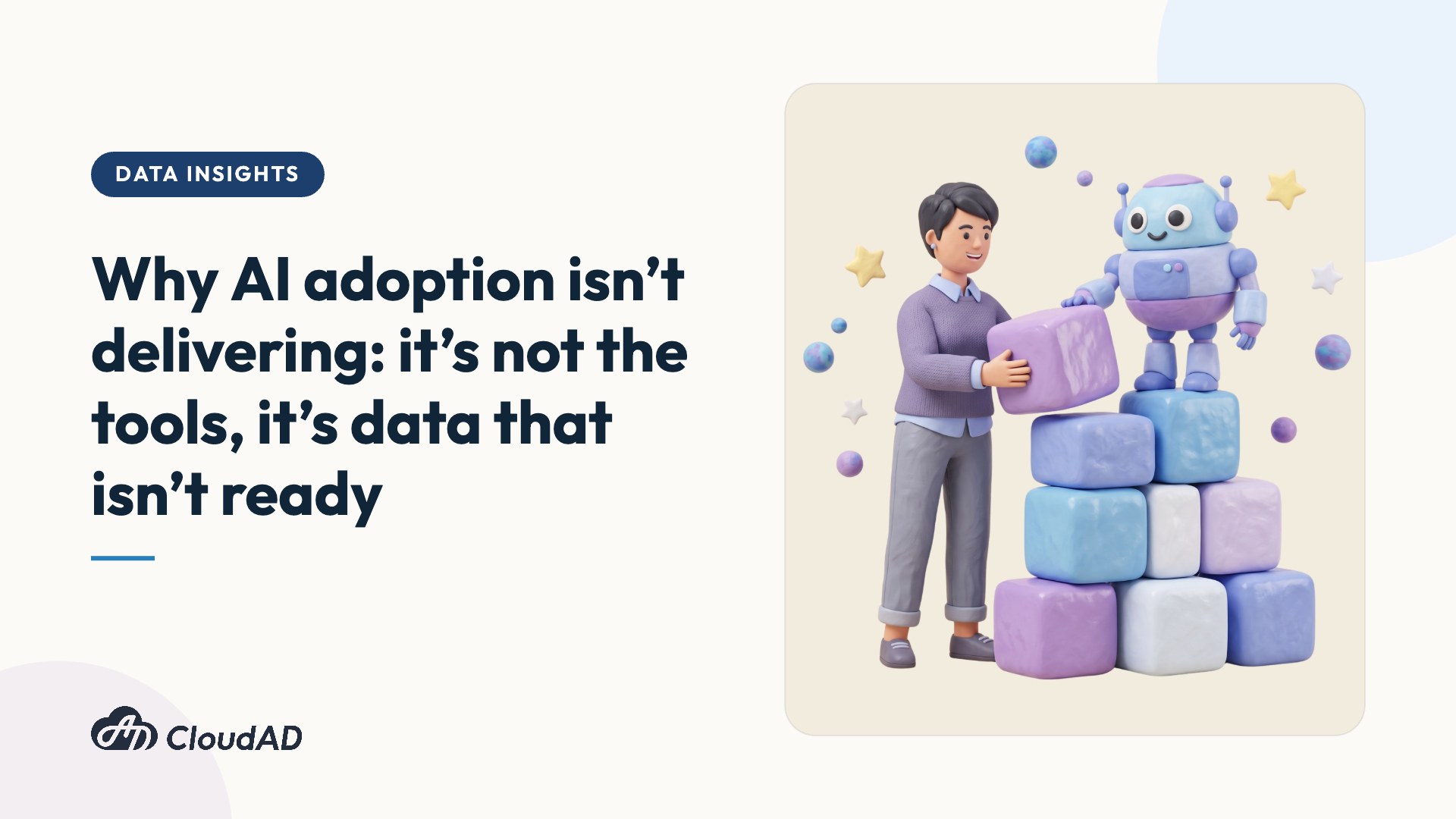
The quality of AI output is determined by the data fed into it. Data-based AI application means first organising the data related to a pain point into trustworthy, structured assets, and then letting AI work on that foundation, rather than building AI directly on top of messy data.
Gartner predicts that by the end of 2026, 60% of AI projects not supported by “AI-ready data” will be abandoned. In the same organisation’s survey, 63% of organisations admitted they either don’t have, or aren’t sure whether they have, data management practices suited to AI. Informatica’s global survey of chief data officers is even more direct: only 12% of organisations believe the quality and accessibility of their data are good enough to support AI applications.
Think of AI as a very capable new colleague: quick to learn and quick to produce. But if on day one they’re handed scattered handover documents and reports that don’t reconcile with each other, even the strongest new hire can’t conjure the right answer. They’ll just produce the wrong thing faster and more convincingly. So organising data is not just an IT preliminary. It is the foundation that sets AI’s ceiling.
| Aspect | Tool-led adoption | Data-based adoption |
|---|---|---|
| Starting point | Buy whatever peers are using | First define the business problem and metrics to improve |
| Role of data | Use whatever is there, launch first | First review and verify the accuracy and structure of the data |
| Typical output | Individual productivity gains (emails, summaries, translation) | Decision support within core processes (audience, budget and content decisions) |
| Validating results | Based on gut feeling, can’t say how much improved | Measured against metrics, verifiable and trackable |
| Knowledge building | Stays in individual chat windows | Captured as reusable organisational assets |
The difference between the two isn’t the model used. The same tool on different foundations produces completely different results.
What should you prepare before adopting AI? Four self-check questions
Is the pain point specific enough to measure, is the data trustworthy, do processes leave a trail, and who makes the final judgement? You can check these four questions yourself without any tools. The question you can’t answer is usually where you should invest first.
- Is the pain point specific enough? (Problem definition) “We want to use AI to improve efficiency” is not a pain point. “Customer service replies take 4 hours on average, and we want to cut that to under 1 hour” is. Only when a pain point is specific enough to have a process and a number can you verify afterwards whether AI helped.
- Is the data trustworthy? (Data quality) Are GA4 events implemented correctly? Do customer lists have duplicates or gaps? Do different departments’ reports use consistent definitions? When data is wrong, AI can’t spot it on its own. It will only magnify the error.
- Do processes leave a trail? (Process legibility) If decision-making logic exists only in senior employees’ heads and in messaging app conversations, AI has nothing to learn from. The AIF survey found that 61.8% of AI use happens outside company control. None of this individual experience is retained as an organisational asset.
- Who makes the final judgement? (Human in the loop) AI gives recommendations, not decisions. Be clear in advance about who verifies, who signs off and which data it’s based on, so that “the AI said so” doesn’t become the reason to act.
Where is the opportunity for Taiwanese SMEs? Turning tacit knowledge into assets AI can use
There is another often overlooked issue: gaps in AI literacy. In the same company, some people have already used AI to rethink how they work, while others only use it to look things up. In the AIF survey, “talent strategy” scored lowest of all sub-items (29.17 points), and 44.7% of companies had no training programme at all. When the gap isn’t noticed and dealt with, simply handing out accounts and buying tools only widens it: the more capable people run faster and faster, while others stay where they are, and the organisation doesn’t get the combined effect it wants. Helping users at different levels collaborate towards the same goal doesn’t depend on more courses. It depends on turning “how to use it, where to use it and what the judgement criteria are” into visible company assets, and reaching agreement across the team.
When every company can use the same models, “whether you use AI” will quickly stop being an advantage. Competition will shift to whether the data fed to AI is nourishment or noise. The AIF survey offers a direction: the real opportunity for Taiwanese companies to differentiate lies in turning years of accumulated industry knowledge, customer data and operational experience, this scattered “tacit knowledge”, into structured data, so that AI can learn from and build on that foundation.
Seen another way, the 61.8% of shadow AI use is actually a signal: employees are already using it, but the company can’t pull together the context of that use. Who is using it, where, and with what effect is hard to measure. What’s often missing isn’t willingness but the design layer that connects single-point uses into a system, and the starting point for that design layer is data.
Data doesn’t make a company grow; decisions made systematically do. The same is true of AI: the model itself won’t make a company faster, but uses that fit into processes and are built on trustworthy data will. Before adopting AI, the step most worth investing in is going back to build the data foundation: define pain points clearly, verify that data is trustworthy, and make sure processes leave a trail. With a solid foundation, whichever tools and models you connect later will have something to work with.
If, after the self-check, you find you’re stuck on data trustworthiness or process trails, that is exactly where CloudAD most often starts helping companies. CloudAD offers Data & AI Consulting, starting with a data health check to confirm the state of your data and define pain points and metrics, then planning how AI fits into your processes. Get in touch, or start with an official GA health check to understand where your data stands.
Frequently asked questions
Do you need a large amount of data before adopting AI?
The point isn’t the amount of data but its trustworthiness and structure. GA4, CRM and POS systems commonly used by SMEs are all foundations that can be organised. First confirm that this data is accurate, then talk about scale and tools.
The company already uses ChatGPT. Does that count as adopting AI?
Improving individual productivity is a good start, but it is single-point use. Whether it counts as adoption depends on three things: whether it has entered core business processes, whether results can be verified against data, and whether the knowledge produced stays in the organisation.
What should an SME’s first step in adopting AI be?
Start with a health check of existing data sources: whether GA4 events are implemented correctly, whether customer lists have duplicates or gaps, and whether departments’ reports use consistent definitions. Only once you’ve confirmed which data is trustworthy will you know where AI can be built or where it can step in.
Is a data-based approach to AI suitable for SMEs too?
Yes, and organising the data costs less than it does for large companies. Fewer data sources means the foundation can be built faster. The key is to start with one specific, measurable pain point rather than aiming for a complete transformation all at once.
What’s the difference between the roles of an AI engineer and a data consultant?
AI engineers are responsible for technical implementation. Data consultants and domain experts are responsible for defining the problem and confirming the data and metrics. The AIF survey warns that expecting engineers to point out the direction for transformation is a common mistake. Technology only has something to work with once there is a clear problem and trustworthy data.
References
・AIF Know!Edge (知勢) | Press release for the “2026 Taiwan Industry AI Adoption Survey”
・AIF Know!Edge (知勢) | AI anxiety and transformation blind spots in Taiwanese industry, 2026
・Manager Today (經理人) | Interpreting the Taiwan industry AI adoption survey
・Fortune | MIT report: 95% of generative AI pilots are failing
・Gartner | Lack of AI-Ready Data Puts AI Projects at Risk
・Folio3 | AI Project Failure Rate (compiling S&P Global and Informatica survey data)