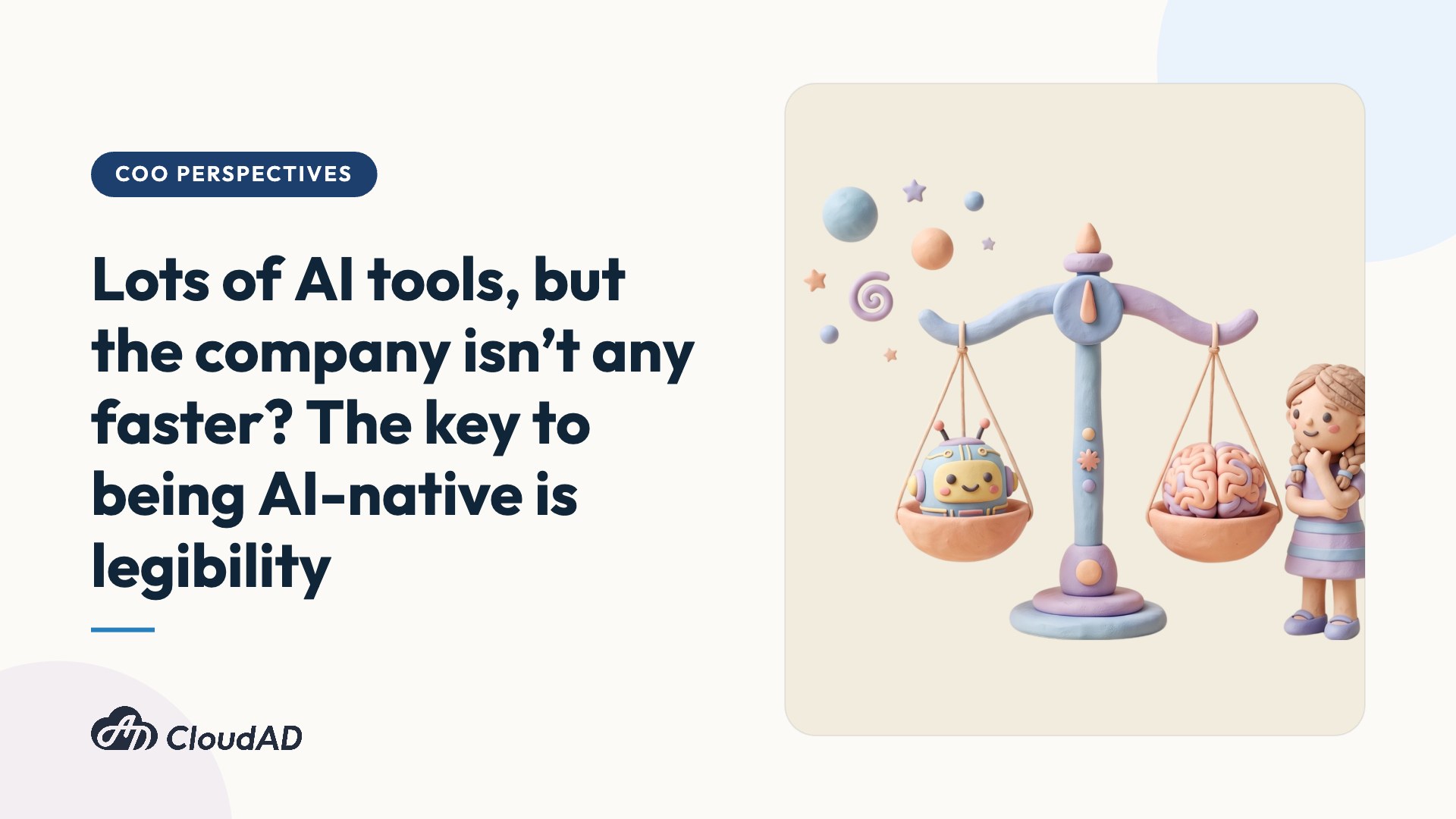
A company adopts a whole range of AI tools, yet it doesn’t get any faster. The problem often isn’t whether the tools are good, but whether the company’s data, processes and judgement are “legible” enough.
I recently read an article by Greg Isenberg about being AI-native that really resonated with me.
As more and more organisations start discussing AI adoption, I increasingly feel that the real core isn’t which tools are used, but whether you can understand the underlying logic behind each industry, each organisation and each everyday workflow.
AI can amplify answers, but only if we first understand the context behind the question.
What is “legibility”?
The concept most worth taking away from the article is legibility.
Being AI-native doesn’t mean “adding AI tools” to existing processes. It means rethinking: if AI is going to produce the first version of the work, what does the company itself need to look like? In other words, making data, processes, experience and judgement organised and understandable, so that AI can help amplify them.
This question matters
Because many AI adoption efforts fail not necessarily because the model isn’t smart enough, or because the tools are hard to use, but because the company’s truth is too scattered.
Client needs are in meeting notes.
Campaign logic is in the optimiser’s head.
Creative judgements are in day-to-day discussions.
Performance changes are in reports.
How exceptions are handled lives in someone’s experience.
If this information isn’t organised, structured and captured, however powerful AI is, it can only see fragments.
The real situation of Taiwanese companies
This view also fits recent signals from Taiwan and international markets.
The Taiwan AI Academy Foundation’s “2026 Taiwan Industry AI Adoption Survey” shows that Taiwanese companies’ AI adoption index rose from 36.77 last year to 47.26, with both awareness and application accelerating. But the survey also notes that many companies still face challenges in governance, processes, talent and adoption methods.
Figures from the Ministry of Economic Affairs show that by the end of March 2026, its industrial competitiveness advisory teams had helped 2,058 companies adopt AI, 91% of them SMEs. AI is no longer just an issue for large companies.
Meanwhile, the Institute for Information Industry’s MIC has observed a “shadow AI” phenomenon among Taiwanese companies: employees using AI tools privately, or companies that haven’t formally adopted AI but don’t prohibit it either. This reminds us that AI has already entered the workplace, and whether companies are ready for AI to be used correctly will be the key to the next stage.
Internationally, McKinsey’s 2026 AI trust report notes that as adoption grows, the risks companies care most about are still inaccuracy and cybersecurity. TechRadar puts it directly: many AI adoption problems are really organisational problems in disguise.
Behind workflows lies accumulated judgement
A company has never been able to function simply because its process maps are complete. What actually keeps work moving is often judgement built up over a long time:
・which things can be standardised
・which things need to stay flexible
・which data needs to be structured
・which exceptions actually hold the most critical organisational knowledge
This is the deepest lesson I’ve learned over nearly 30 years of working across industries, organisations, departments and cultures. Along the way I learned not just how to get work done, but how to observe how daily operations really work, how workflows are systematised, and how tacit experience can be turned into knowledge the team can understand, reuse and keep improving.
What this means for a data company
CloudAD’s specialism has always been data. But data shouldn’t be understood only as reports, charts or performance figures. Its deeper value is making judgements understandable, trackable and reusable.
For example: why does a high CTR for a set of creatives not necessarily mean the quality is good? Why might an audience that performs well in the short term not be suitable for scaling up in the long term? Why, when a client says they want to drive traffic, might what they actually need be lead nurturing afterwards?
If these judgements exist only in one person’s head, they’re hard for the team to share and hard for AI to help with. So for us, being AI-native isn’t just everyone starting to use AI to write copy and produce reports. It’s making work more “legible”: turning search signals into insight about demand, turning creative performance into consumer response, and turning the results of every campaign into knowledge that can be used next time.
Cleaning data, writing SOPs, defining fields, recording decisions: this work isn’t glamorous, but it determines whether AI can genuinely help.
Of course, this article shouldn’t be taken wholesale either
The author mentions that “there may be only 1,000 truly AI-native companies in the world”. That’s more rhetoric than rigorous data. And turning people’s tacit judgement into explicit rules isn’t simply hard graft. Much of how exceptions are handled, how clients feel, brand judgement and market intuition is part of professional value in the first place, and can’t be completely replaced by documents.
So this is how I read it: the direction is worth adopting, but don’t take the numbers literally. Being AI-native isn’t about chasing tools. It’s about reorganising how the company works, how it retains knowledge and how data supports judgement.
There’s no standard answer, and it’s hard to copy someone else’s playbook directly. Only by first understanding your own industry context, organisational logic and real workplace can you develop an AI-native workflow that genuinely suits your company.
Finally, three questions for anyone thinking about AI adoption:
Are the numbers you see every day organised into signals the team can understand?
After every important discussion, are the key judgements recorded?
Does each round of execution make the next one faster and more accurate, or does it start from scratch?
In future, AI will make many operations faster. But what really sets companies apart may not be who uses the most AI tools, but whose company is more legible.
References
・Greg Isenberg | How to become “AI-Native”
・Taiwan AI Academy Foundation | 2026 Taiwan Industry AI Adoption Survey
・Ministry of Economic Affairs | Seizing the golden period of AI development to accelerate SME adoption
・Institute for Information Industry MIC | Top 10 technology trends for 2026
・McKinsey | State of AI trust in 2026
・TechRadar | AI adoption problems are usually organizational problems in disguise