The news over the past six months has had a strange rhythm that is hard to put into words. In the first half of the year, more than 100,000 job cuts were attributed to AI. A few months later, a third of those companies quietly hired people back into the same roles. Most reports focused on companies reversing their decisions, but I kept thinking of a different picture: the engineer who was laid off and then rehired, and what was going through their mind on the day they sat back down at their desk…
What this large-scale experiment proved
IBM used AI to take over HR work. It handled 94% of routine requests but got stuck on the remaining 6%, and IBM later announced it would expand hiring. Ford brought back 350 senior engineers because automated quality control couldn’t catch the problems experienced hands could see. It reminded me of the days in 2012 when I lived and worked in Hangzhou. One night my car broke down. The technician plugged it into a computer and found nothing wrong. Then an old master mechanic appeared, listened to it and said exactly where the problem was. More than a decade on, machines have gone through several generations, but this hasn’t changed. In Orgvue’s survey, 39% of business leaders had made layoffs because of AI, and 55% of them later admitted it was a mistake. To be fair, being willing to admit a mistake is still a good thing.
Six months of upheaval led to a clear conclusion: machines can handle routine work, but not judgement. And judgement is something that grows over many years of working through processes. It includes mistakes made, the process of correcting them, and watching how the people next to you handle difficult problems. Layoffs often cut exactly these assets, which live in people and don’t show up on the books.
In human–AI collaboration, it’s people who collaborate first
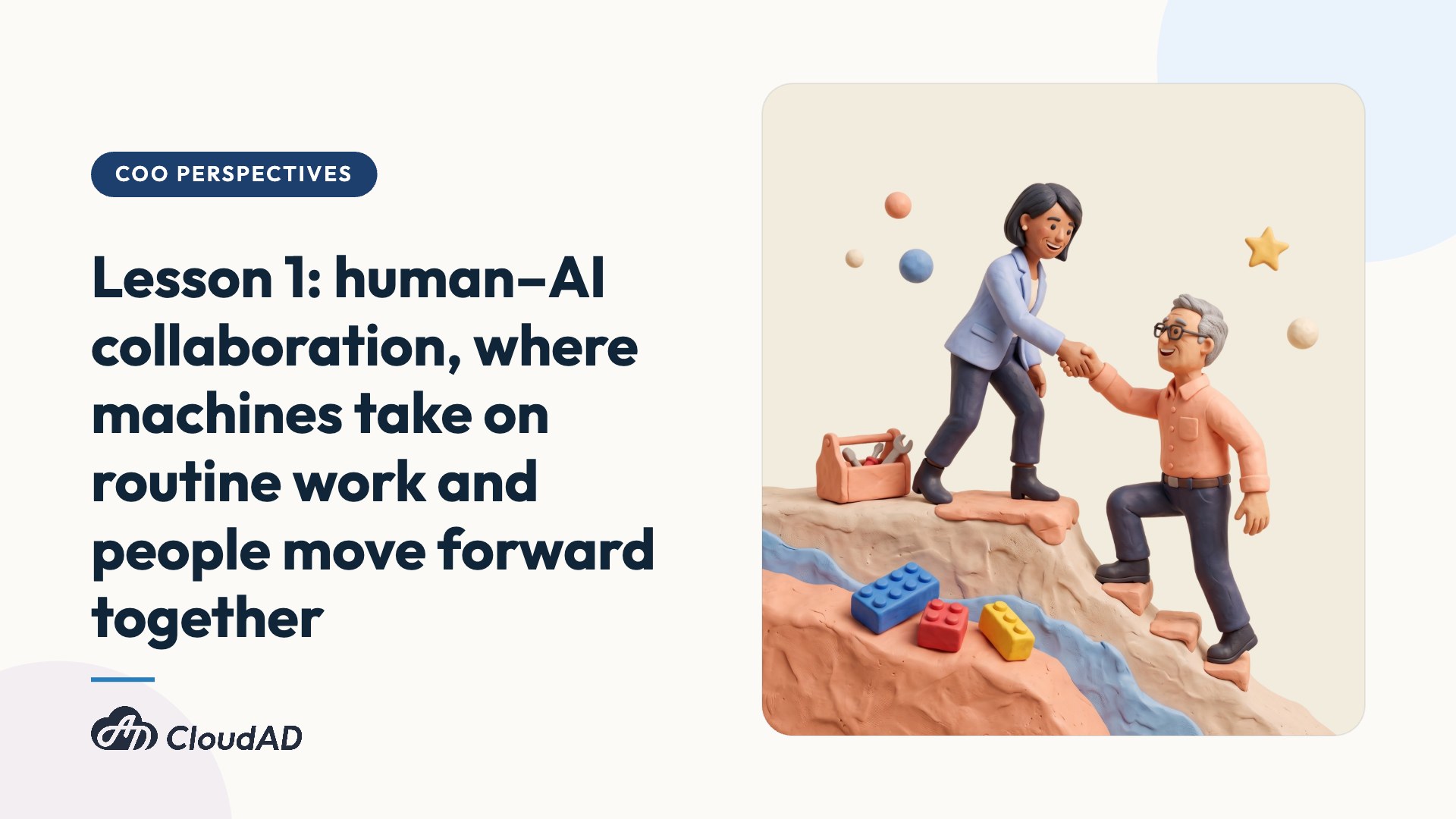
When people talk about human–AI collaboration, most imagine one person paired with one machine, each with their own tasks. But since a large part of judgement is learned from the people around you, human–AI collaboration has a foundation that is often skipped: collaboration between people, exchanging experience and passing on judgement.
Data has measured this gap. BCG’s AI at Work survey found that more than 85% of users remain at the stage of asking AI to do things for them, and fewer than 10% have reached deep collaboration. The same survey has another counter-intuitive figure: 75% of managers use generative AI several times a week, compared with only 51% of frontline employees. The gap sits closer to the management office door than you might think. In Taiwan, in AIF’s survey of AI adoption across industries, talent strategy scored lowest of all dimensions, and 44.7% of companies had no training programme at all.
Put these numbers back into everyday life and the picture is familiar. People who pick it up quickly keep their prompts and judgement in their own windows. People who haven’t got to grips with it yet, in an atmosphere where everyone says AI is easy, don’t really dare to say they’re stuck. One side’s knowledge isn’t retained, the other side can’t bring themselves to ask, and the distance between them grows every week. Most companies have no design for this, only various expectations.
What CloudAD does
Our company has this gap too, and there’s no need to pretend otherwise. This year, when I was putting together our internal proposal training materials, I wrote one sentence on the first page: those leading are learning too, and nobody knows everything at the start. I wrote this deliberately because once the person teaching is put in a position where they can’t be wrong, learners don’t dare reveal where they’re stuck, and collaboration between people declines as a result. I have to say, I understand that engineers dread trial and error most of all, but I always feel (for myself) that finding the next way out through mistakes is how I grow the most.
We’re doing two other things as well. The first is breaking down senior colleagues’ judgement into materials people can choose from. How to segment audiences, how to match media: these become a box of Lego bricks. Newcomers start learning by choosing, which lowers the barrier. The second is work logs for new starters, so that the places where they get stuck are written down, and the focus of feedback is on turning individual sticking points into input for the next version of our processes. Companies that move quickly on human–AI collaboration have usually got the people-to-people part right first. We are working hard in that direction.
Some caveats, and three questions
When I cite these surveys, I leave myself some room. The reports on layoffs and rehiring are mainly compiled from individual cases, and it will take time to know whether they represent the whole picture. BCG’s definition of “use” is quite loose. The link between training hours and confidence in using AI may simply be because proactive people are more willing to attend courses, or more willing to speak up. The direction is worth considering, but stay sceptical about the details, which is good practice for training your own critical thinking.
Finally, I’ll leave three questions:
- How can the most valuable judgement in the company be written down?
- Who is quietly falling behind? Who will sit down next to them?
- If AI takes over another 30% of routine work tomorrow, how will the people who remain prepare to support one another?
The machine side will keep getting faster, but the human side can’t be rushed, and doesn’t need to be. The “slow” part is exactly where the value lies.
It’s late at night as I write this, which is fine. Night is suited to slowness. After using up so much System 1 during the day, System 2 can be left for practice at night, a nod to Thinking, Fast and Slow.
References
・CNBC | Employers who laid off workers citing AI are starting to regret it
・Forbes | AI Layoffs Are Backfiring
・BCG | AI at Work: Momentum Builds, but Gaps Remain
・AIF Know!Edge (知勢) | 2026 Taiwan industry AI adoption survey