KEY POINTS
Key points
- What it means to “know AI” depends on the team, the role and the goal. A slogan is not a definition.
- Before changing a report or adding a tool, ask who uses it, why it isn’t working, and how long the problem will last.
- Use AI as a thinking partner: say your idea clearly in writing or by voice, then question its assumptions and the angles it missed.
- A workflow needs resilience (it can recover when something breaks) and flexibility (one method does not have to fit everyone).
Since AI arrived, work has started to look very different for different people. Some people raise their own AI, like me. Some use the tools their company provides. Others are still watching from the side, wondering what AI really has to do with their work.
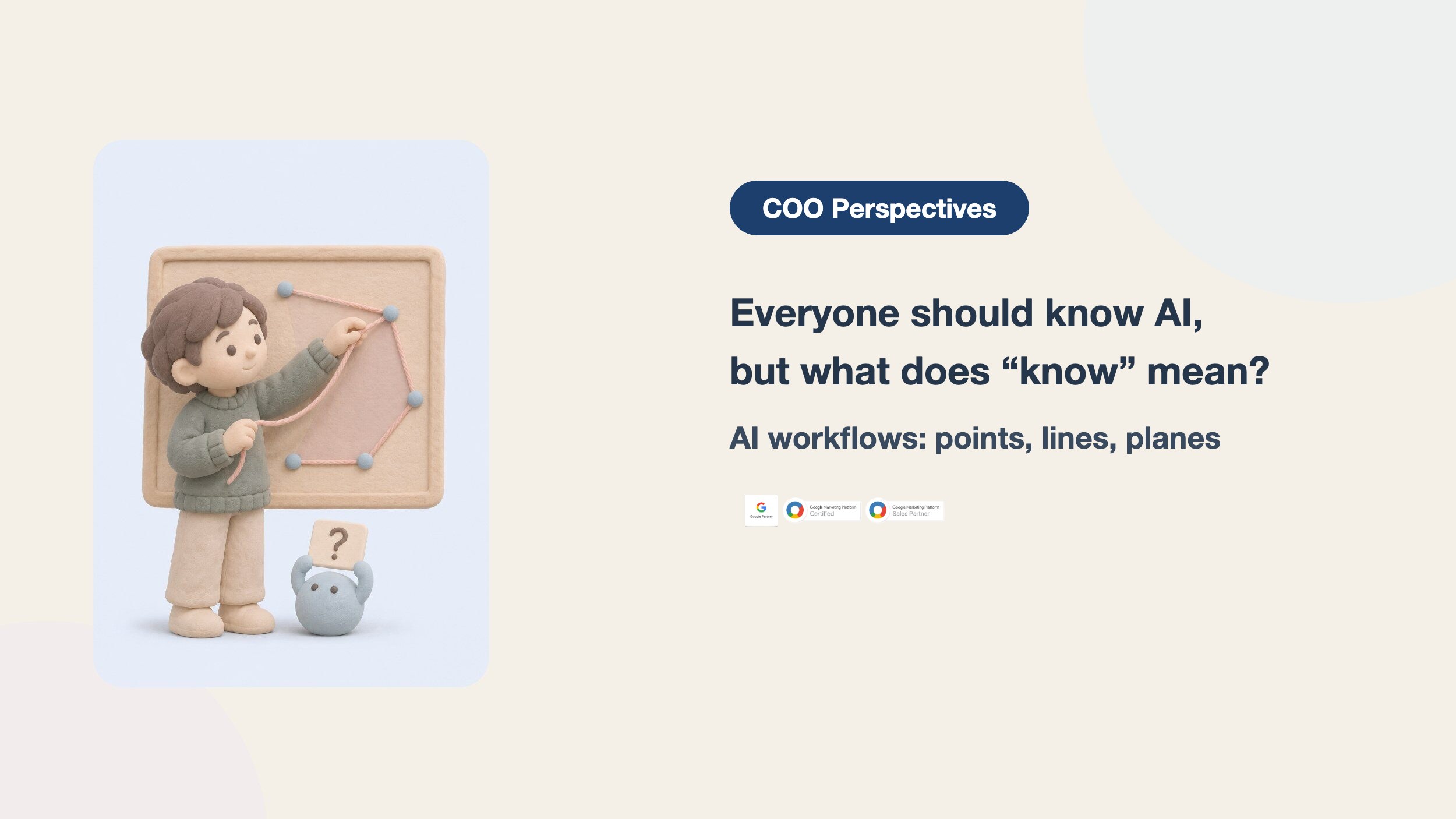
There is no shortage of tools. The hard part is connecting the tools to the work, because what we see in the moment is usually just one point. It reminds me of a study guide I used as a kid called “Points, Lines, Planes”: a point of knowledge has to connect into a line, and lines have to open up into a plane, before you see the whole picture. Work is the same. It needs dimension, breadth and depth.

Sometimes, when I see someone already using AI smoothly, I feel a little jealous. Then I ask myself one more question: what am I envious of? Their tools, their output, or the fact that they have found a way of working that suits them? Once I answer that, I know what I actually want to learn, and I don’t need to rush to copy someone else’s approach.
This piece starts from “points, lines, planes” to talk about workflows in the age of AI, about resilience and flexibility, and in the end, about what really matters.
1. “Everyone should know AI.” But what does “know” mean?
Many companies now say that everyone should know AI. The direction is right, but different teams, roles and goals need different kinds of knowing. A salesperson using AI to organize client needs and an engineer using AI to help write code are two different working situations. If there is only a slogan, with no clarity on how far people need to go, it easily turns into adding a tool or running a course every time a problem shows up.
Here is an everyday example. Someone finds a report hard to use, and the first reaction may be to change the report right away. Before touching it, I would first ask:
- In what situations do users find it hard to use? What do they want to see in it, and what decisions do they make with it?
- What might “hard to use” be about? The interface, the parameters, the presentation, or the process around the report?
- If the report became easier to use, how would users’ work change? Where could we see the difference?
- How long will this problem last? Can today’s change still serve what we need next?
Writing these questions down often shows that what needs to change is not the report, but the process of using it, or what people expect from it. Only once the question is clear do we know whether AI can help, and where to start.
So for me, knowing AI means being able to state the work problem you want to solve, going back and forth with AI, checking its answers, and putting the answer back into your work. It is not about how many tools you know, and not everyone has to use the same method. Different roles need different skills and learning paths, but we can discuss together what kind of use actually helps the work.
Standards matter. They give a team a shared language and a basic way of working. But within shared standards, there still has to be room for human judgment and flexibility. A good workflow does not replace every point with AI. It starts with a good question, then decides which points are worth connecting into a line.
2. How does AI help me think? I treat it as a sparring partner
For me, AI does not draw conclusions for me. It helps me slowly lay out ideas I haven’t sorted through yet. When I type, I often think as I write, and AI follows up with questions. Sometimes I talk with ChatGPT in voice mode to say a half-formed idea out loud, or use speech-to-text to turn what is in my head into words, then come back and organize it.
I have always valued writing and verbal expression. Tools can catch ideas, but people still have to shape them. The more clearly I can say the question in my mind, the better I can go back and forth with AI, and the easier it is to find out what I really want to ask.
I ask AI to help me look in a few more directions:
- What do you hear that I actually want to deal with?
- From what other angles could this be understood?
- How might a client, a colleague or a user see it from where they stand?
- What unspoken assumptions are hidden in my current thinking?
- Which parts of this question deserve more thought?
AI’s answers are often complete and fluent, but a complete answer does not mean the thinking is done. I keep asking: how else could this answer be read? Is an important angle missing? If the premise changed, would the conclusion change?
Handing a question to AI is fast. Letting the question take me a few steps further is the thinking practice I want. Judgment and decision-making grow slowly through this kind of repeated questioning.
3. A workflow needs resilience, and it needs flexibility
The two words often appear together, but I think they mean different things.
Resilience is a workflow’s ability to recover and keep running after something goes wrong. If a tool stops working for a while, how does the work continue? Can someone take over? Is there another way to do it? These are questions a team can think about when it designs its workflows.
Flexibility means not applying one method to everyone. Each role does different work and may need different tools, ways of learning and levels of skill. If a company sets one standard without looking at what people actually need to get done, the standard can easily become another constraint.
“Free size” clothing is a good example. It doesn’t mean everyone fits, but within a certain range, most people have room to adjust. In Taiwanese there is a word for this kind of give, 伸縮 (tshun-sok). I also think of the Japanese word asobi (遊び), which I borrow here for its sense of leaving some slack, so things have room to move and adjust.
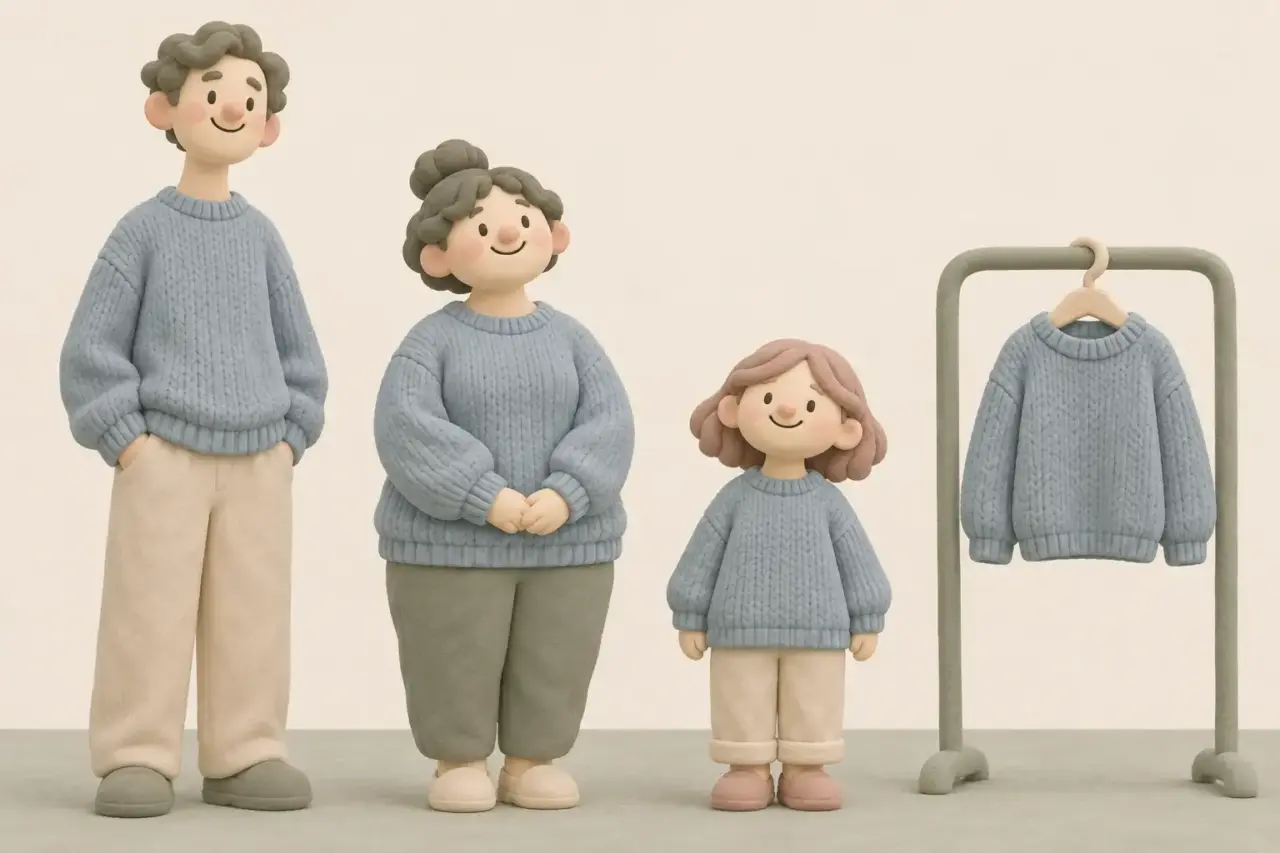
Looking at AI adoption through equality and equity shows two different arrangements:
| Equality | Equity | |
|---|---|---|
| Meaning | Everyone receives the same arrangement | Different support for different needs, aiming for a fair chance |
| In AI adoption | Everyone takes the same course, uses the same tool and meets the same standard | Define the skills each role and goal needs, and offer different starting points and learning paths |
Shared standards tell a team where it is heading. Flexibility lets different people find the way that suits them within that direction. The two can exist together. The key is whether we are willing to ask one more question: who does this arrangement help, and who needs different support?
Closing: what really matters?
This is a hard question, because everyone brings their own ideas, background and experience. I think a workflow that truly creates value has to be more than workable. The people who actually use it have to understand it and want to use it. However complete a design is, if nobody uses it, it ends up as a nice-looking diagram.
To get there, decision-makers need to listen. Not to make everyone happy, but to understand the difficulties people face and what they really care about. After listening, they also need to explain the decision clearly: why are we doing it this way? Where do we already agree? Where is there still room to adjust?
Back to points, lines and planes. AI has made many points in our work faster, but it is still people who connect points into lines and open lines into planes. Sometimes envy shows us what we want to learn. How we move forward still comes back to our own work, goals and judgment.
Ask good questions first. Use AI to practice thinking. Let your workflow recover when something goes wrong, and leave a little room for different ways of working. That, I think, is what really matters in the age of AI.
FAQ
My company wants everyone to “know AI.” What is the first step?
Start by discussing, by team, role and goal, what knowing AI means for each kind of work. Then decide which tools to learn and which skills to practice.
What is the difference between resilience and flexibility in a workflow?
Resilience means the process can recover and keep running after something goes wrong. Flexibility means adjusting the approach to different situations and needs, instead of asking everyone to use the same method.
I’m jealous of people who use AI better than I do. Can that help?
First ask yourself what you envy: the tools they use, the results they produce, or the fact that they have found a way of working that suits them. That envy may show you what you really want to learn.
Further reading
- Lesson 1: human–AI collaboration, where machines take on routine work and people move forward together
- Can you trust what AI tells you? When users state a view first, models agree with the wrong answer 63.7% of the time
- Lots of AI tools, but the company isn’t any faster? The key to being AI-native is legibility