1. Introduction: how AI tools are changing user research
In digital marketing research, user surveys and focus group interviews have long been key ways for brands to understand consumer needs and behaviour. But traditional methods take a great deal of time and resources. From designing questions and recruiting participants to analysing data, the process is laborious and expensive.
With advances in AI, generative AI tools such as Google Gemini let marketers quickly simulate responses from different audiences, using AI as “respondents” in research to gain early market insights in a short time. With well-designed prompts, AI can play different consumer roles, answer market research questions and even analyse large volumes of responses, providing key guidance for marketing decisions.
2. Writing effective AI prompts to guide responses
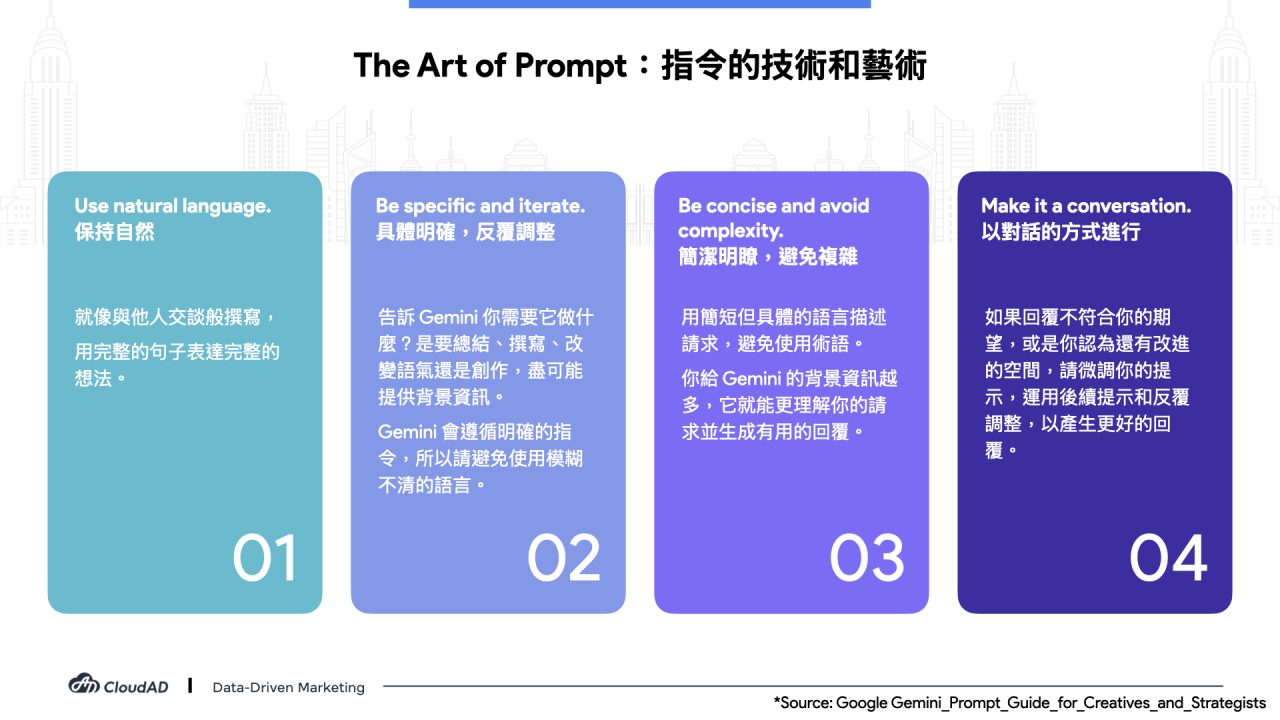
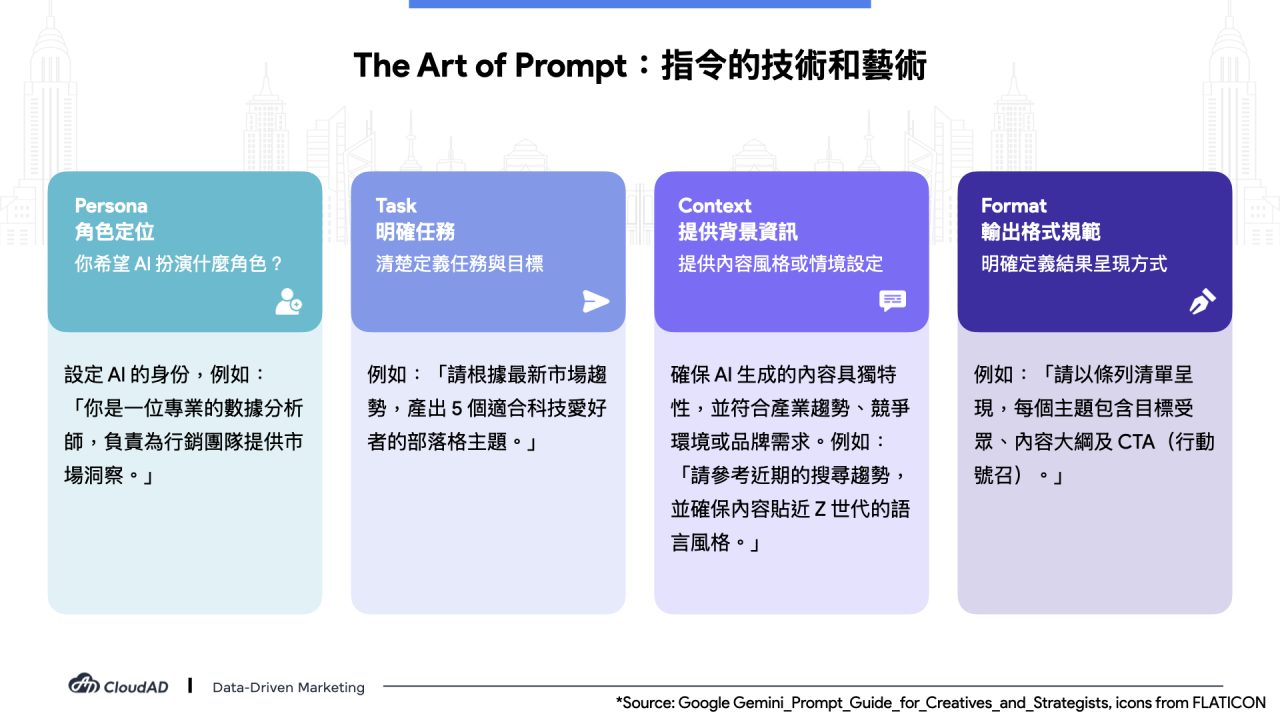
To make AI an effective respondent, the key is prompt design. Clear role setting, goal definition, background information and output format rules help AI produce more useful responses.
1. Set a clear persona
Specify the AI respondent’s background in the prompt so that responses reflect the mindset of the target group. For example:
- “You are a 25-year-old tech enthusiast who follows the latest smartphone developments.”
- “You are a consumer interested in sustainable products and are looking for an eco-friendly shampoo.”
2. Define the task clearly
Explain clearly what the AI needs to do. For example:
- “Based on your personal traits and needs, answer the following interview questions.”
- “Describe your first impression of this ad and give three specific reasons.”
3. Provide suitable context
Add background information to make the AI’s responses more realistic. For example:
- “This product is from a new brand in the Taiwan market, targeting young people aged 18–35.”
4. Set the format for clearly structured responses
Ask the AI to respond in bullet points or full sentences so the results are easy to read. For example:
- “Answer in three paragraphs, each containing one key point and a specific example.”
3. Key ways to use AI in user research
1. Generate focus group questions
AI can quickly produce a set of market research questions, such as:
- “What is the core message of this ad?”
- “Would you recommend this product to a friend? Why?”
- “Does the product’s price meet your expectations?”
2. Simulate respondents’ answers
Marketers can have AI play different respondents to test how the market reacts to a product or ad.
- Marketer: “This coffee machine promotes a smart brewing feature. Would you be interested?”
- AI respondent A (coffee lover): “I’m very interested, especially if I can adjust the strength and flavour.”
- AI respondent B (average consumer): “If the price is too high, I’d probably still choose pour-over.”
3. Text analysis and sentiment detection
AI can run semantic analysis on respondents’ answers to identify keywords and sentiment trends. For example:
- “90% of respondents expressed interest in a free trial.”
- “The main negative responses were about high prices or too many features.”
4. Case study: how Hatch and Monks used AI focus group interviews
1. Background: using AI to find new target audiences
Hatch planned to launch its new Restore 2 smart clock and wanted to expand into markets it had not reached before. With limited time and budget, Monks turned to Gemini to help analyse market opportunities.
2. AI as focus group respondents
- Gemini first carried out market analysis, reviewing social trend reports, search queries, industry research and competitor data to identify suitable target audiences.
- Using AI, Monks identified three core audiences: the Stressed Professional, the Biohacker and the Wellness Enthusiast.
- Monks then had Gemini play these three personas in interviews to understand their interests, lifestyle habits, aesthetic preferences and sleep needs in depth.
3. Creating personalised ad content
- Traditional marketing strategies usually deliver a single message, but Gemini let the team tailor ad content to the needs of different audiences.
- Through Gemini, Monks understood how each audience thought about “sleep” differently and created core messages to match their needs.
- For example, the Stressed Professional needs a relaxing sleep environment to relieve stress, while the Biohacker is interested in technology that optimises sleep quality.
With Gemini, Monks could quickly identify suitable audiences and interview them in depth, then design ad content that better matched market needs. This made the marketing strategy more precise and removed the time-consuming, resource-intensive audience research process of the past, helping the brand reach potential customers faster and more effectively.
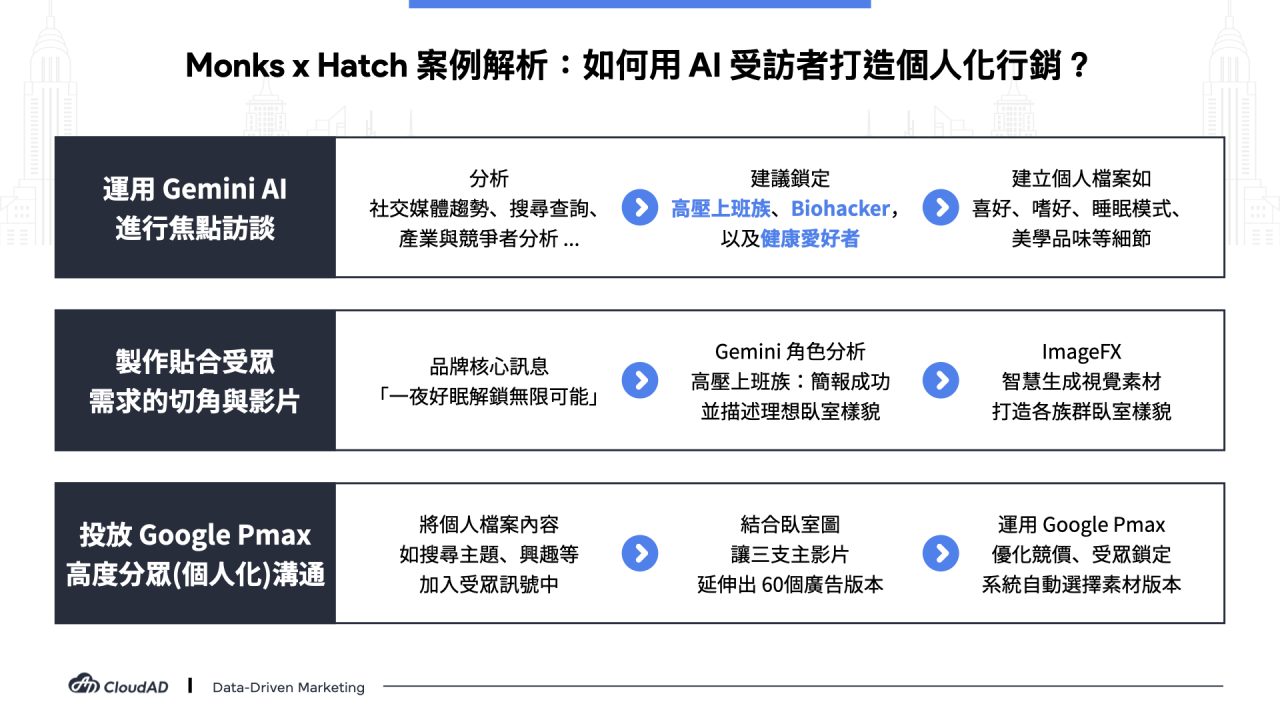
Source: Think with Google, https://www.thinkwithgoogle.com/marketing-strategies/automation/monks-ai-personalization-advertising-campaign/
5. Conclusion: using AI to strengthen digital marketing research
AI respondents offer a new way to do market research, letting marketers gain audience insights quickly. With well-designed prompts, AI can simulate real respondents and help marketing teams shorten testing time. However, AI cannot fully replace real interviews. It should be used as a supporting tool to help refine question design and interview strategy.
Future trends
- AI respondents will develop further, giving more human-like responses through more precise data training.
- Combining AI respondents with human research will create a more flexible and efficient market research model.
With AI respondents, digital marketers can capture market reactions faster and more accurately and gain an edge in marketing decisions.
In the digital age, GA4 is not just a tool for large enterprises. If you want to ride this wave of data, get in touch.