What is Google Tag Gateway (GTG)?
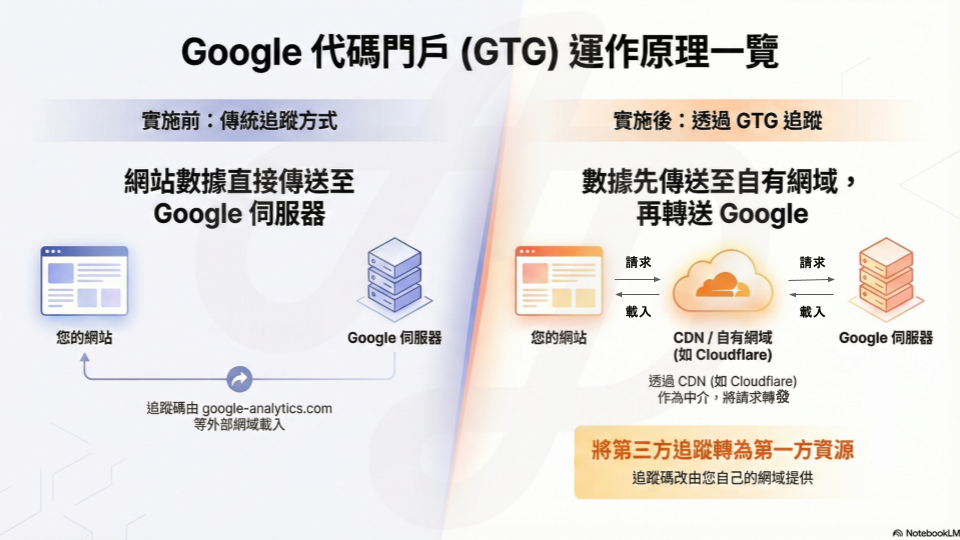
Google Tag Gateway (GTG) is a technology that changes how the code for Google’s tracking tools (such as GTM, GA4 and Google Ads) is loaded and sent: instead of external code served from Google’s servers (a third-party resource), it is loaded through your own website’s domain (a first-party resource).
Put simply, GTG lets your website run Google’s tracking code safely on your own domain, reducing the risk of browser blocking or data loss.
Why do you need Google Tag Gateway?
As browsers restrict third-party cookies more and more tightly, traditional tracking faces many challenges, such as blocked tracking signals and incomplete data. GTG was introduced to solve these problems and improve the completeness and accuracy of website data.
How it works
GTG creates an intermediate layer (for example, Cloudflare) between your website and Google’s servers. This layer sits under your own domain, and it is this layer that requests and loads Google’s libraries (such as GTM or gtag.js).
Main benefits:
- More accurate and reliable data: GTG turns Google tags into first-party resources, reducing the impact of browsers blocking third-party resources and increasing the number of valid data signals. This improves data completeness and makes ad attribution and audience analysis more accurate, helping you optimise your media strategy.
- Ready for privacy trends: GTG uses technology that puts more emphasis on privacy and security, and is better aligned with future privacy policies and trends.
- A cost-effective alternative: For businesses that lack technical resources or don’t want to take on extra costs, GTG offers a simple, quick and free alternative to server-side tracking.
Which businesses is it suitable for?
- Corporate websites or e-commerce platforms built around GA4, GTM and Google Ads
- Businesses that care about data completeness and conversion accuracy
- Companies that want to keep a data advantage as privacy regulations tighten and in a cookieless era
- Businesses without full server-side tracking capabilities that want to improve data collection quickly
Limitations
- Limited resistance to blockers: GTG can reduce interference from some browsers and extensions, but more sophisticated tools (such as Ghostery) may still block analytics requests.
- Cannot extend cookie lifetime: GTG does not change the browser’s limits on cookie lifetime (such as ITP). If you need a longer tracking window, you still need a full server-side GTM implementation.
Although GTG cannot collect all data, it can effectively reduce data loss, helping businesses evaluate marketing performance more accurately and see the real return on ad investment. As privacy awareness grows and the cookieless era arrives, GTG has become a key tool for businesses to stay competitive with their data.
If you are thinking about how to improve the quality of your data tracking or strengthen your GA4 and marketing data strategy, get in touch and we will help you find the right solution.